
Shaping Brands. Driving Growth.
DIGITAL MARKETING SOLUTIONS IN NOIDA
Strategic Digital Marketing for Visibility, Demand Generation & Business Growth
Digital marketing plays an important role in how businesses build visibility, communicate their value, reach relevant audiences, and develop new business opportunities. However, sustainable results require more than isolated campaigns or activity across multiple platforms. In fact, they require a clear strategy, consistent communication, relevant content, and a structured approach to performance measurement.
At Pixel Crafters, we develop Integrated Digital Marketing Solutions for B2B companies, startups, corporate businesses, and growing brands.
Furthermore, our approach brings together Search Engine Optimization (SEO), Social Media Marketing (SMM), Content Marketing (CI), LinkedIn Marketing, Paid Advertising, and Performance Analysis to support defined business objectives.
Based in Noida, we work with businesses across Delhi NCR and India. As a result, we help them connect their digital presence with their broader brand positioning and growth priorities.
Digital Marketing Is More Than Online Promotion
A business can have a professional website, strong products, and valuable expertise yet struggle to reach the right audience online. In fact, in other cases, marketing activity generates traffic and engagement but does not translate into meaningful business enquiries.
Moreover, these challenges often arise when marketing channels operate independently, communication lacks consistency, or campaign activity is not connected to clear business objectives.
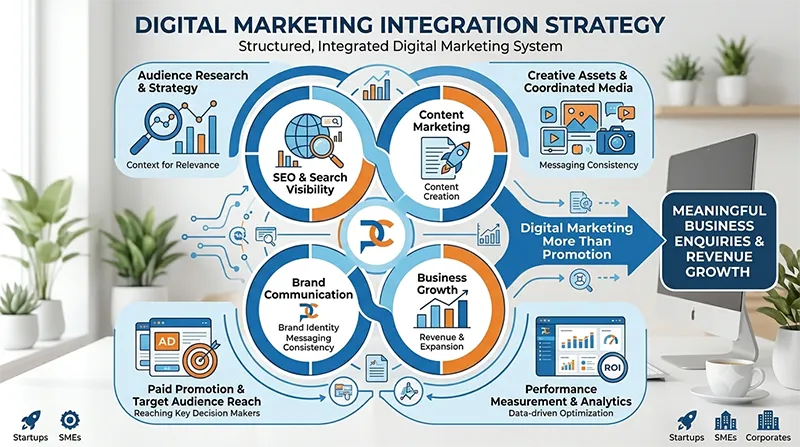
Consequently, a structured digital marketing approach helps businesses address these gaps by connecting audience research, search visibility, content, creative communication, paid promotion, and performance measurement.
At Pixel Crafters, we consider digital marketing as part of a wider business system. Therefore, the objective is to help businesses become more discoverable, communicate their value more effectively, reach relevant prospects, and understand how their marketing activity contributes to business goals.
Specifically, depending on your requirements, this may involve strengthening an existing digital presence, introducing a new brand to the market, improving lead generation, or developing a more coordinated marketing approach.
What Digital Marketing Can Help Your Business Achieve
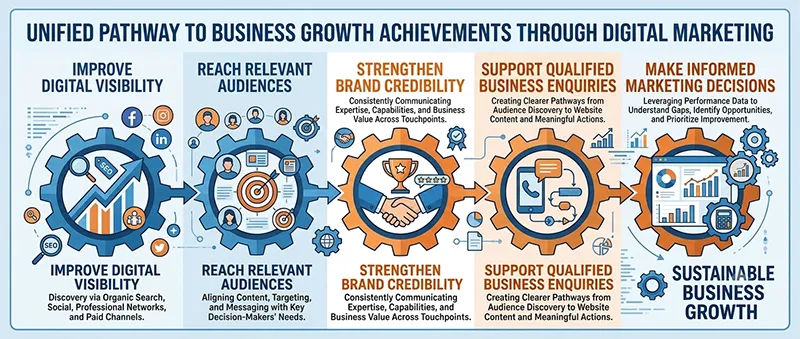
Improve Digital Visibility
Help relevant audiences discover your business through organic search, professional networks, social platforms, and selected paid channels effectively.
Reach Relevant Audiences
Additionally, align content, targeting, and messaging with the interests, requirements, and decision-making needs of your intended audience.
Strengthen Brand Credibility
Furthermore, communicate your expertise, capabilities, products, and business value consistently across important digital touchpoints.
Support Qualified Business Enquiries
As a result, create clearer pathways from audience discovery to relevant website content, service information, consultation requests, and other meaningful actions.
Make Better-Informed Marketing Decisions
Consequently, use available performance data to understand what is working, identify gaps, and prioritize opportunities for improvement.
These outcomes depend on the business model, market conditions, marketing investment, offer, execution quality, and sales process. Digital marketing should therefore be planned around realistic objectives rather than unsupported promises.
Search Engine Optimization (SEO)
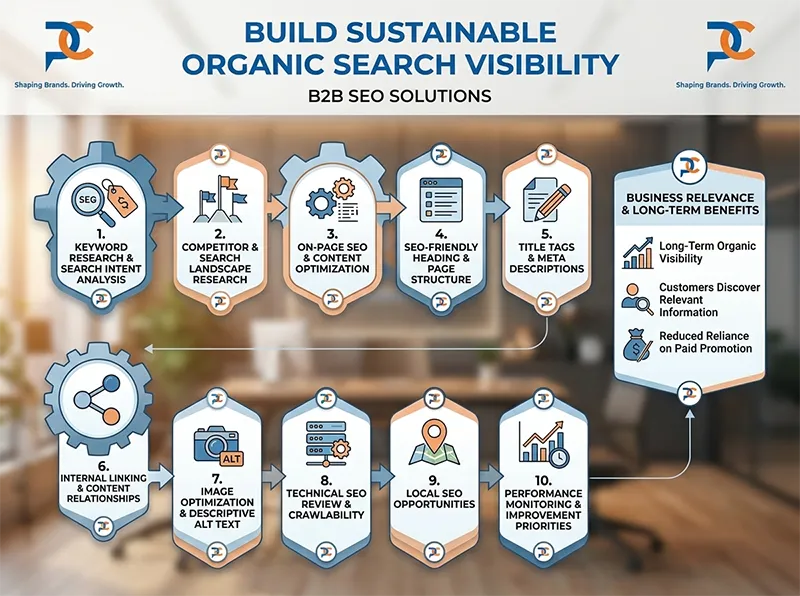
Build Sustainable Organic Search Visibility
Search engine optimization helps improve how your website and its content are understood and discovered through relevant organic search results. Specifically, it connects what people are searching for with useful information about your business, products, services, and expertise.
For B2B companies, SEO can support discovery at different stages of the buying journey. In fact, prospects may search for a solution to a business problem, compare providers, research a specific capability, or look for a specialist in their location.
Therefore, our SEO approach focuses on aligning website content and structure with search intent while improving clarity, relevance, and discoverability.
SEO activities can include:
Keyword research and search intent analysis
Competitor and search landscape research
On-page SEO and content optimization
SEO-friendly heading and page structure
Title tags and meta descriptions
Internal linking and content relationships
Image optimization and descriptive ALT text
Technical SEO review and crawlability considerations
Local SEO opportunities for relevant business searches
Performance monitoring and ongoing improvement priorities
Business relevance: As a result, SEO can support long-term organic visibility and help potential customers discover relevant business information without relying exclusively on paid promotion. Progress depends on competition, website condition, content quality, authority, and other factors.
Social Media Marketing (SMM)
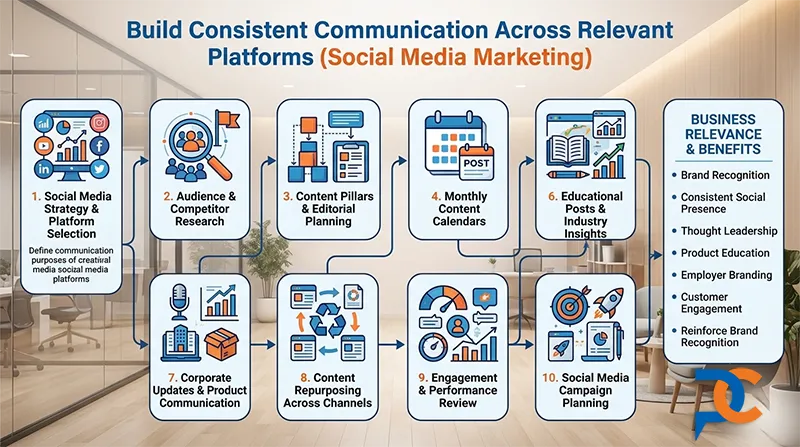
Build Consistent Communication Across Relevant Platforms
Social media marketing helps businesses maintain an active and coherent presence, communicate expertise, share useful information, and develop relationships with relevant audiences. Specifically, for B2B and corporate brands, social media should serve a defined communication purpose. In fact, depending on the audience, that purpose may include brand awareness, thought leadership, product education, employer branding, customer engagement, or support for broader marketing campaigns.
Therefore, Pixel Crafters approaches social media through a combination of strategy, content planning, visual communication, and performance review.
Social media activities can include:
Social media strategy and platform selection
Audience and competitor research
Content pillars and editorial planning
Monthly content calendars
Branded graphics and campaign creatives
Educational posts and industry insights
Corporate updates and product communication
Content repurposing across relevant channels
Engagement and performance review
Social media campaign planning
Moreover, the choice of platforms should reflect where your intended audience is active and how they use each platform. Maintaining every social media channel is not necessary for every business.
Business relevance: Ultimately, a consistent social presence can reinforce brand recognition, communicate expertise, and support other marketing activities by giving prospects additional opportunities to understand your business.
LinkedIn Marketing for B2B Businesses
Connect Business Expertise with Professional Audiences
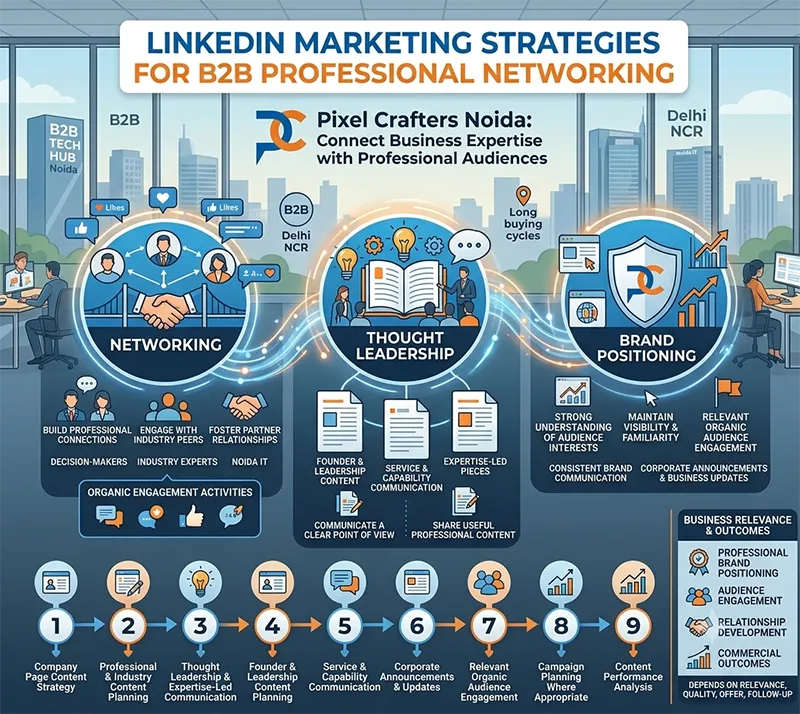
LinkedIn can be a highly relevant channel for B2B businesses seeking to communicate with professionals, business leaders, industry peers, potential partners, and decision-makers. Indeed, effective LinkedIn marketing requires more than publishing occasional company updates. In practice, it benefits from a clear point of view, useful professional content, consistent brand communication, and a strong understanding of the audience’s business interests.
Accordingly, LinkedIn marketing activities can include:
Company page content strategy
Professional and industry-focused content planning
Thought leadership and expertise-led communication
Founder and leadership content planning
Service and capability communication
Corporate announcements and business updates
Relevant organic audience engagement
LinkedIn campaign planning where appropriate
Content performance analysis
Furthermore, for B2B companies with longer buying cycles, LinkedIn content can help maintain visibility and familiarity while prospects research potential partners and evaluate business capabilities.
Business relevance: Consequently, LinkedIn marketing can support professional brand positioning, audience engagement, and relationship development. Commercial outcomes depend on the relevance of the audience, content quality, offer, and follow-up process.
Content Marketing
Turn Business Expertise into Useful Digital Content
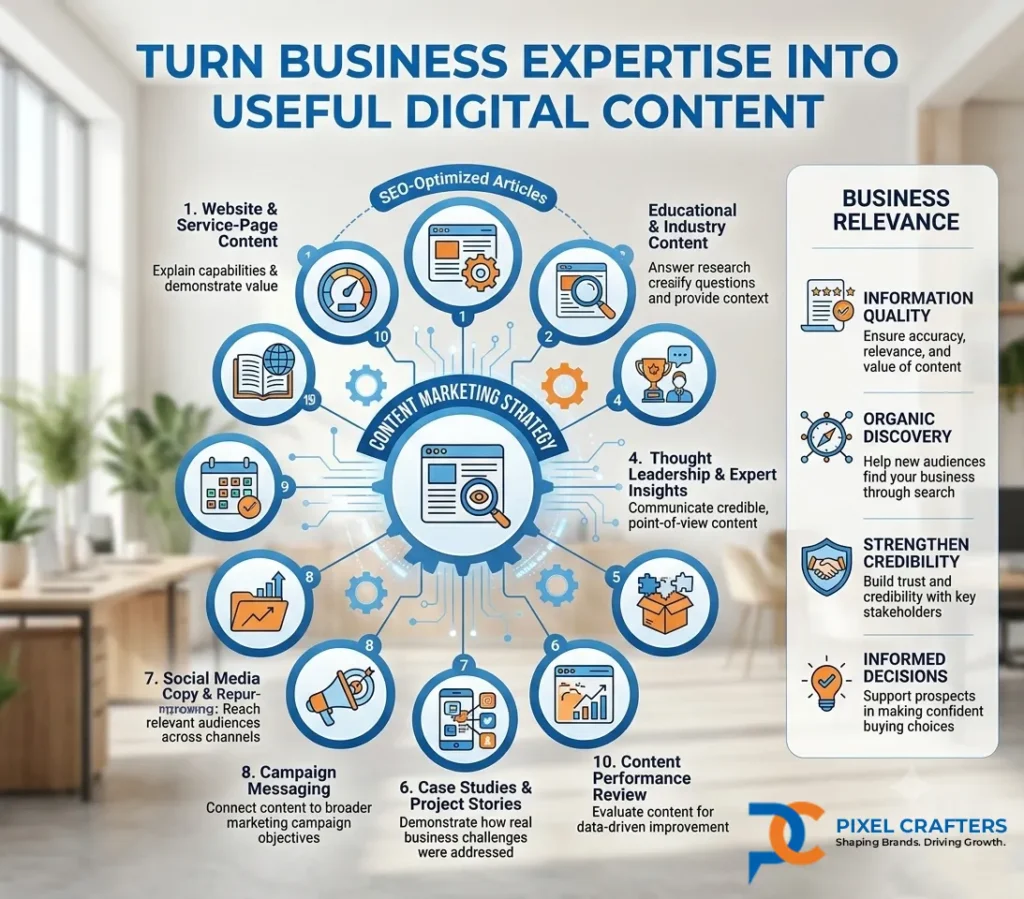
Content marketing helps businesses explain what they do, demonstrate their expertise, answer audience questions, and communicate their value throughout the customer journey. In fact, in B2B markets, buying decisions often involve research, comparison, multiple stakeholders, and a need for credible information. Therefore, useful content can help prospective customers understand a business problem, evaluate possible solutions, and assess a provider’s capabilities.
At Pixel Crafters, content planning considers both search relevance and the role each piece of content plays in the wider business communication system.
Content marketing activities can include:
Website and service-page content
SEO-focused articles and blog posts
Educational and industry-specific content
Thought leadership and expert insights
Product and solution explainers
Case studies and project stories
Social media copy and content repurposing
Campaign messaging and supporting content
Content calendars and publishing priorities
Content performance review
Specifically, content should have a clear purpose. For instance, a service page may explain a capability, an article may answer a specific research question, and a case study may demonstrate how a business challenge was addressed.
Business relevance: In effect, a structured content approach can improve information quality, support organic discovery, strengthen credibility, and help prospective customers make more informed decisions.
Google Ads & Paid Search Advertising
Reach Relevant Search Demand Through Paid Campaigns
Google Ads allows businesses to promote relevant offerings through paid search placements and other available advertising formats. Specifically, it can be useful when a business wants to reach people searching for specific solutions, products, or services.
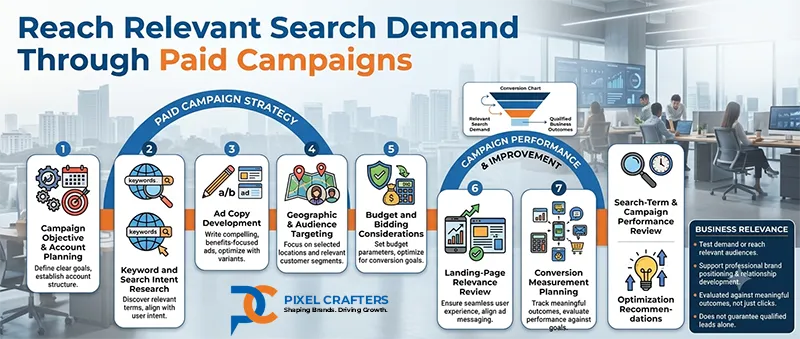
In practice, paid advertising requires more than selecting keywords and setting a budget. Therefore, campaign objectives, search intent, audience relevance, messaging, landing-page experience, conversion measurement, and ongoing evaluation all influence performance.
Paid search activities can include:
Campaign objective and account planning
Keyword and search intent research
Campaign and ad group structure
Ad copy development
Geographic and audience targeting
Budget and bidding considerations
Landing-page relevance review
Conversion measurement planning
Search-term and campaign performance review
Optimization recommendations
Furthermore, the appropriate campaign structure depends on the business, market, competition, available budget, and conversion objectives. In short, campaigns should be evaluated against meaningful outcomes rather than clicks alone.
Business relevance: From a strategic standpoint, paid search can provide visibility for selected search queries and help businesses test demand or reach relevant audiences. However, it does not guarantee qualified leads, sales, or profitability.
Note: Advertising spend paid to the platform should be distinguished from professional planning, management, creative, and optimization fees.
Paid Social Media & Digital Campaigns
Extend Marketing Reach Beyond Organic Content
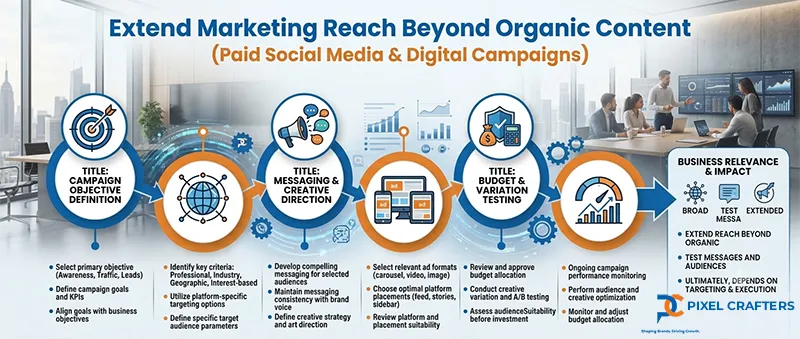
Paid social advertising can help businesses distribute relevant messages to selected audiences beyond their existing organic reach. Depending on the platform and campaign objective, it can support awareness, content distribution, product promotion, audience engagement, or lead generation.
In fact, campaign planning should consider audience suitability, creative quality, offer relevance, message consistency, and the action expected from the audience.
Paid social activities can include:
Campaign objective definition
Audience and geographic targeting
Campaign messaging and creative direction
Ad format and placement planning
Creative variation and testing
Landing-page and lead-form considerations
Budget allocation review
Campaign performance monitoring
Audience and creative optimization
Furthermore, for B2B businesses, paid social may be useful when the intended audience can be identified through relevant professional, industry, geographic, or interest-based criteria. Therefore, platform suitability should be assessed before investment.
Business relevance: Looking at the overall impact, paid social can extend campaign reach and help businesses test different messages and audiences. Ultimately, results depend on targeting, offer quality, creative execution, competition, and the customer journey.
Performance Marketing & Campaign Optimization
Connect Marketing Activity with Measurable Objectives
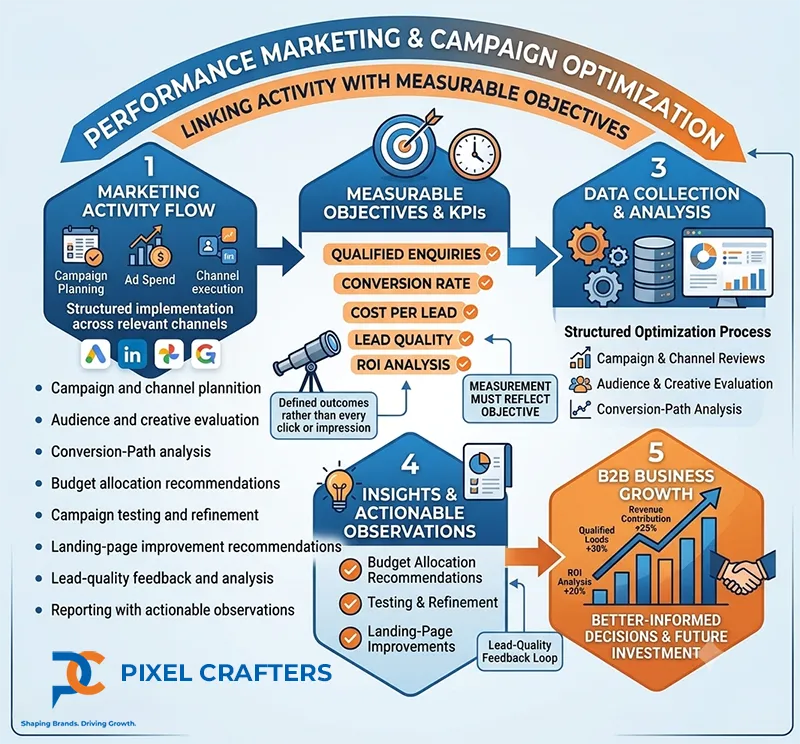
Performance marketing places emphasis on defined outcomes, measurement, and structured optimization. Specifically, rather than treating every click, impression, or interaction as equally valuable, it evaluates activity in relation to the business objective.
In practice, depending on the campaign, relevant measures may include qualified enquiries, conversion rate, cost per lead, lead quality, customer acquisition cost, or revenue contribution where reliable data is available.
Performance marketing activities can include:
Campaign objective and KPI definition
Measurement and reporting planning
Campaign and channel performance reviews
Audience and creative evaluation
Conversion-path analysis
Budget allocation recommendations
Campaign testing and refinement
Landing-page improvement recommendations
Lead-quality feedback and analysis
Reporting with actionable observations
Therefore, measurement must reflect the objective. For instance, a campaign intended to generate qualified B2B enquiries should not be judged solely by impressions or low-cost clicks.
Business relevance: In practical terms, a structured performance approach helps businesses understand campaign efficiency, identify improvement opportunities, and make better-informed decisions about future marketing investment.
Local SEO & Location-Based Digital Visibility
Help Relevant Customers Discover Your Business Locally
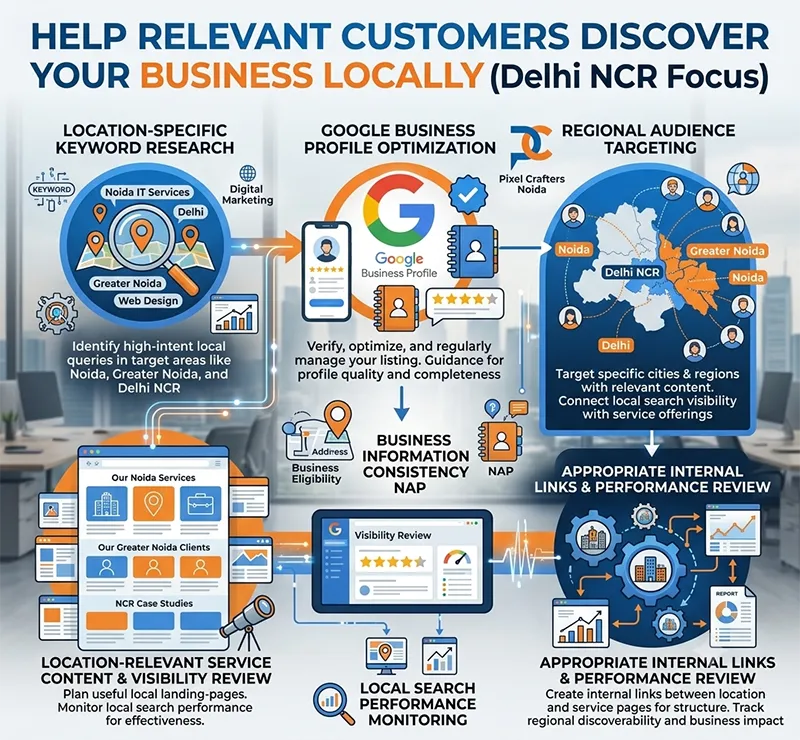
For businesses serving specific cities or regions, local search visibility can be an important part of digital marketing. For instance, prospective customers may search for a service provider in Noida, Greater Noida, Delhi NCR, or another relevant location.
In response, Local SEO focuses on helping search engines and potential customers understand where a business operates and which local searches are relevant to its offerings.
Local SEO activities can include:
Location-specific keyword research
Relevant local landing-page planning
Business information consistency
Google Business Profile optimization guidance where applicable
Location-relevant service content
Local search visibility review
Appropriate internal links between location and service pages
Monitoring relevant local search performance
Importantly, location pages should offer useful, accurate information rather than duplicate the same content with different city names.
Business relevance: From a regional perspective, Local SEO can help improve discoverability for geographically relevant searches. Ultimately, outcomes depend on competition, business eligibility, location relevance, profile quality, and other factors.
Digital Marketing Analytics & Reporting
Understand What Your Marketing Activity Is Telling You
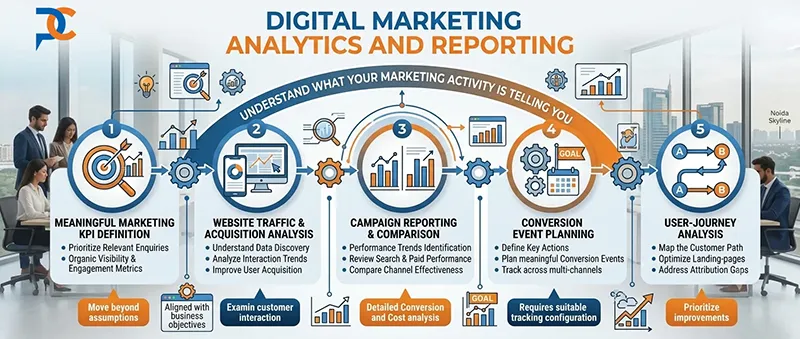
Analytics helps businesses move beyond assumptions by examining how people discover, navigate, and interact with their digital presence. Specifically, the right measurement approach depends on the business objective. For instance, a corporate website may prioritize relevant enquiries, while a content programme may focus on organic visibility and engagement. Meanwhile, paid campaigns may require more detailed conversion and cost analysis.
Analytics activities can include:
Definition of meaningful marketing KPIs
Website traffic and acquisition analysis
Search performance review
Campaign reporting and comparison
Conversion event planning
Landing-page and user-journey analysis
Enquiry-source and lead-quality review where data is available
Identification of performance trends
Recommendations for future marketing priorities
In addition, reliable measurement requires suitable tracking configuration, clear definitions, and appropriate access to the relevant data sources. However, attribution may remain imperfect when customers interact with multiple channels or devices.
Business relevance: On the whole, Analytics provides a stronger basis for understanding performance, prioritizing improvements, and aligning marketing activity with business objectives.
Digital channels are most useful when their roles are understood and coordinated. Specifically, SEO, content, social media, paid advertising, and website experience should not operate as disconnected activities without a shared direction.
For example, an SEO strategy may identify the information potential customers are searching for. Simultaneously, content marketing can address those questions, while social media helps distribute relevant insights. In addition, paid campaigns may target selected opportunities, and consequently, the website provides the information visitors need to evaluate the business and take the next step.
Thereafter, analytics helps the business assess what is happening across these activities and where improvement may be possible.
At Pixel Crafters, we therefore consider the relationship between these capabilities when planning digital marketing priorities. In fact, the right combination depends on business goals, available resources, market conditions, and the stage of growth.
Ultimately, not every business needs every channel immediately. In short, a focused and well-coordinated approach may be more appropriate than spreading resources across too many activities.
How Our Solutions Work Together
Brand & Creative Solutions
Build a Consistent and Recognizable Brand
Brand & Creative Solutions help businesses establish a clear visual identity and communicate their value consistently across customer touchpoints. Specifically, from brand identity and graphic design to marketing collateral and campaign creatives, these capabilities help translate brand positioning into meaningful visual communication.
In addition, a consistent creative system also supports digital marketing by ensuring that advertising, social media content, website visuals, and sales materials communicate a recognizable brand message. Therefore, maintaining visual consistency across all channels creates stronger brand recall, while ultimately making future marketing efforts much more effective.
Website & Digital Solutions
Create a Strong Digital Foundation
Website & Digital Solutions focus on website design, user experience, WordPress development, and digital platforms that help businesses present their offerings clearly and professionally. Specifically, a well-structured website supports digital marketing by giving visitors relevant information, while helping them evaluate products and services, and providing clear pathways to enquiries.
In fact, website content, usability, performance, and mobile experience all influence how effectively a digital presence supports business objectives. Therefore, prioritizing a seamless digital structure ensures higher engagement, which ultimately converts casual visitors into qualified business leads.
Digital Marketing Solutions
Connect Your Business with Relevant Audiences
Digital marketing solutions help businesses improve online visibility, reach relevant audiences, communicate expertise, and develop new business opportunities. Specifically, capabilities include search engine optimization, social media marketing, content marketing, paid advertising, and performance analysis.
When coordinated with brand communication and website experience, digital marketing helps businesses connect audience discovery with useful information and meaningful next steps. Ultimately, the right approach depends on the target market, business objectives, available resources, and stage of growth.
Motion & Video Solutions
Communicate Ideas Through Motion and Storytelling
Motion & Video Solutions help businesses communicate complex ideas, demonstrate products, explain services, and present brand messages through engaging visual storytelling. Specifically, motion graphics, animated explainers, promotional videos, and other video content can support digital campaigns, social media communication, presentations, product launches, and corporate communication.
When aligned with brand strategy and marketing objectives, motion content can make information easier to understand and, consequently, make campaigns far more engaging.
Events & Exhibition Solutions
Bring Your Brand into Real-World Experiences
Events & Exhibition Solutions help businesses present their brands through physical environments, exhibition spaces, event branding, and experiential communication. Specifically, from exhibition stall design and brand environments to event graphics and on-ground activations, these capabilities help translate brand identity into tangible experiences.
In addition, they can complement digital marketing by supporting product launches, industry exhibitions, corporate events, and audience engagement beyond online channels. Consequently, combining physical presence with digital outreach builds a much stronger overall brand impact.
Production & Print Solutions
Maintain Quality Across Physical Brand Touchpoints
Production & Print Solutions help businesses translate creative concepts into finished communication materials for practical use across marketing, sales, events, and corporate environments. Specifically, depending on project requirements, this may include print collateral, brochures, catalogues, promotional materials, signage, and related production coordination.
In addition, consistent execution helps maintain brand quality and accuracy when creative assets move from design to physical output. Therefore, ensuring precise production standards protects brand integrity across all offline touchpoints.
Digital Marketing for Every Stage of Business Growth
LAUNCH
Establish Your Digital Foundation
When new brands, startups, and businesses enter a market, initially, the first priority is to establish a clear and credible digital presence.
Specifically, marketing at this stage may involve defining target audiences, identifying relevant search opportunities, structuring website content, preparing core messaging, selecting suitable platforms, and planning initial campaigns.
Ultimately, the objective is to establish a focused foundation that can support future marketing activity without unnecessary complexity.
GROW
Build Visibility and Reach Relevant Audiences
As businesses seek to expand their reach, typically, the focus may shift towards improving organic visibility, strengthening content, building a consistent social presence, and testing suitable paid campaigns.
At this stage, businesses can evaluate which channels attract relevant audiences, which messages communicate value most effectively, and consequently, which activities contribute to meaningful enquiries.
Ultimately, the objective is to develop a more consistent and informed marketing approach.
SCALE
Improve Performance and Coordination
With established marketing activity, specifically, priorities may include improving conversion paths, refining targeting, evaluating lead quality, coordinating channels, and making more informed investment decisions.
In addition, structured measurement and ongoing optimization can help identify performance gaps and opportunities as business requirements evolve.
Ultimately, the objective is to improve the effectiveness and coordination of marketing activity rather than simply increasing the number of campaigns.
Our Digital Marketing Process
Discover & Understand
We begin by understanding your business model, target audience, current digital presence, competitive environment, and growth objectives. Specifically, this provides the context for deciding which marketing activities are most relevant.
Research & Strategy
Next, we assess search opportunities, audience needs, channel suitability, content requirements, and potential areas for improvement. Consequently, priorities are aligned with business objectives and available resources.
Plan & Develop
Thereafter, we organize the agreed direction into a practical plan covering content, campaigns, creative requirements, implementation priorities, timelines, and measurement considerations.
Execute & Coordinate
The selected activities are implemented across the agreed channels. Specifically, messaging, creative assets, website content, and campaign objectives are coordinated to maintain consistency
Measure & Evaluate
We review available performance data against the defined objectives. As a result, this helps distinguish activity metrics from outcomes that are more relevant to the business.
Optimize & Improve
Based on available evidence, we identify potential improvements, refine priorities, and recommend the next steps. Ultimately, the process evolves as the business, market, and performance insights change.
Why Choose Pixel Crafters for Digital Marketing?
Strategy Before Execution
We begin with business objectives, audience requirements, and market context before recommending channels or campaign activity. Specifically, this structured approach ensures that every decision is aligned with your core goals.
A B2B-Oriented Perspective
B2B marketing often involves multiple decision-makers, longer evaluation periods, and a greater need for clear information. In addition, our approach considers these requirements when planning content and communication.
Creative & Digital Alignment
As a strategy-led B2B creative agency, Pixel Crafters connects digital marketing with brand communication, creative development, and website experience. Consequently, this creates a unified brand presence across all touchpoints
Integrated Solution Thinking
Our solutions are designed to complement one another. Therefore, businesses can address relevant priorities across branding, website development, and digital marketing without treating every requirement as an unrelated activity.
Clear Objectives and Practical Evaluation
We emphasize defined objectives, relevant performance measures, transparent communication, and realistic expectations rather than guaranteed rankings or unsupported growth claims. Ultimately, this transparency builds long-term trust and sustainable results.
A Flexible Approach to Business Growth
Marketing requirements change as businesses launch, grow, and scale. As a result, the appropriate strategy should evolve with the audience, market, available resources, and business priorities.
Frequently Asked Questions About Digital Marketing
What digital marketing solutions does Pixel Crafters offer?
Pixel Crafters offers digital marketing solutions covering SEO, social media marketing, LinkedIn marketing, content marketing, Google Ads, paid social campaigns, performance marketing, local SEO, and analytics-related planning. The appropriate combination depends on your business objectives and requirements.
Is digital marketing suitable for B2B companies?
Yes. Digital marketing can help B2B companies improve discoverability, communicate expertise, reach relevant decision-makers, and support business enquiries. The strategy should account for the buying process, the information prospects need, and the time required to evaluate a potential supplier.
How is SEO different from paid advertising?
SEO focuses on improving organic search visibility through relevant content, website structure, and other search optimization activities. Paid advertising provides sponsored visibility through advertising platforms. Both can serve useful but different roles, depending on the business objective, competition, budget, and timeline.
Do businesses need every digital marketing channel?
No. The appropriate channels depend on the target audience, offering, objectives, resources, and competitive environment. A focused strategy that prioritizes the most relevant opportunities may be more effective than spreading resources across every platform.
How long does digital marketing take to show results?
Timelines vary by activity. Paid campaigns can begin generating traffic after launch, while meaningful business outcomes depend on campaign quality, audience relevance, the offer, and conversion readiness. SEO and content marketing generally require sustained work to develop organic visibility. Specific rankings, leads, and revenue cannot responsibly be guaranteed within a fixed period.
Can digital marketing help generate B2B enquiries?
Digital marketing can support enquiry generation by improving discoverability, communicating relevant information, reaching suitable audiences, and creating clearer paths to contact. The quality and volume of enquiries also depend on the offering, market demand, website experience, budget, and follow-up process.
Does Pixel Crafters provide digital marketing in Noida and Delhi NCR?
Pixel Crafters is based in Noida and serves businesses across Delhi NCR and India. Project requirements, suitable channels, scope, and delivery arrangements can be discussed according to the business objectives.
How do we choose the right digital marketing strategy?
The process begins with understanding your business goals, target audience, current digital presence, challenges, and available resources. These factors help determine which channels and activities should be prioritized and how their performance should be evaluated.
Can digital marketing work with branding and website development?
Yes. Brand positioning, creative communication, website experience, and digital marketing can complement one another. A consistent brand message and useful website content can strengthen the wider digital experience and support marketing objectives.
How can we discuss our digital marketing requirements?
You can contact Pixel Crafters with a brief description of your business, target audience, current marketing challenges, and primary objectives. This provides a starting point for discussing relevant priorities and a practical scope of work.
Build a More Focused Digital Growth Strategy
Digital marketing works best when it is aligned with the business it is intended to support.
Whether you are launching a new brand, strengthening an existing digital presence, or looking for a more coordinated approach to marketing, Pixel Crafters can help you explore the relevant capabilities and priorities for your next stage of growth.
Let’s discuss your business objectives and identify a practical direction for your digital marketing.